

5W USDX QRP HF Transceiver All Mode SSB CW AM FM with BNC Connector for 15M 20M 40M Bands, CW Decoder and Keyer Support, Black Aluminum Body, 80x40x100mm, 1 Set
Product details
| Management number | 221445778 | Release Date | 2026/05/03 | List Price | US$47.44 | Model Number | 221445778 | ||
|---|---|---|---|---|---|---|---|---|---|
| Category | |||||||||
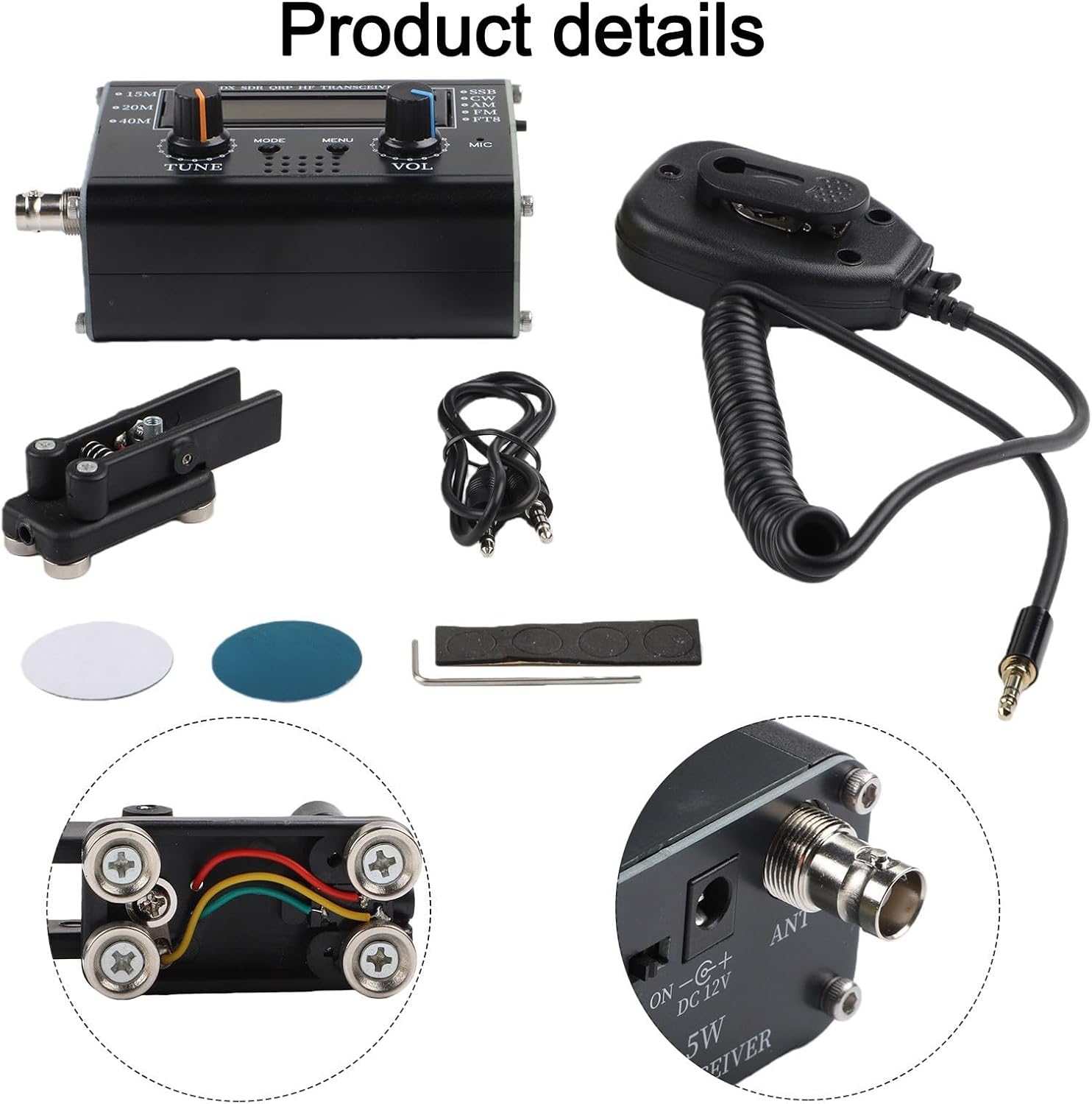
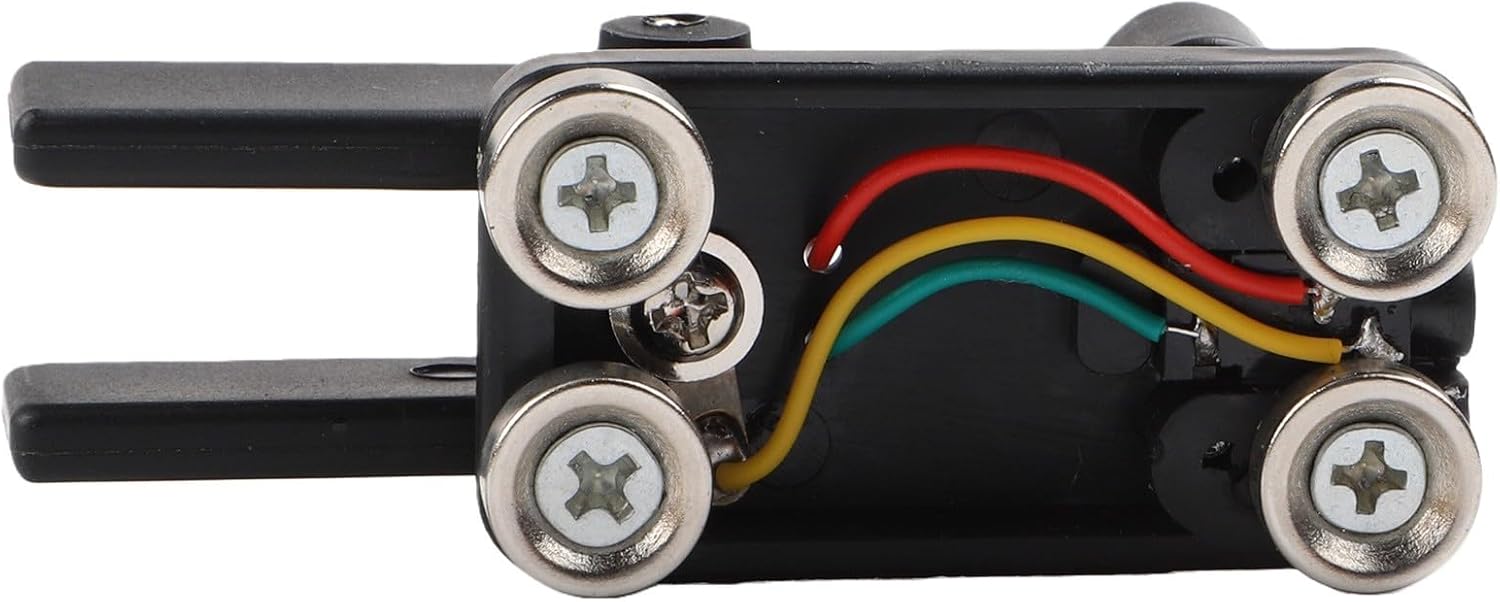
Features:* This is a shortwave QRP SSB/CW transceiver. It has a 1602 screen, built-in microphone, built-in speaker! It can be connected to the auto key and can decode via CW.* Adopts IRF series transmitting tube, which is sturdy and practical.* Connect the antenna and it can be used (BNC connector).* 3 frequency bands. Power standing wave digital display!* Marking on aluminum shell.USDX software open source;- https://.com/threeme3/QCX-SSB/tree/feature- for RX-improvedSome hardware open source websites;- https://dl2man.de/- https://antrak. for org.tr/blog/projeler/usdx-an-for arduino-based-all-mode-hf-transceiver-pcb-iteration-v1-02/- https://www.qsl.net/py2ohh/trx/usdx/usdx.htmlGroup;- https://groups.io/g/ucx/topicsSpecifications:Name: TransceiverMaterial: MetalSize: 80 40 x 100mmColor: BlackFeature List;- Simple, fun, versatile QRP SSB HF transceiver with embedded for DSP and capabilities.- EER Class E driven SSB transmitter stage.- 12V power supply provides about 5W Max PEP SSB output.- Full mode support: USB, LSB, CW, AM, FM.- For DSP : 4000, 2500, 1700, 500, 200, 100, 50Hz passband.- For DSP functions: Automatic Gain Control (AGC), Noise Reduction (NR), Voice Trigger, Voice Trigger Xmit, for RX Attenuator Attenuator (ATT), TX Noise Gate, TX Driver Control, Volume Control, dBm/S-meter.- SSB Anti-Sideband/Carrier Suppression Transmit: Better than -45dBc, IMD3 ( for two-tone) -33dBc, Receive: Better than -50dBc.- Multi-band support, continuously adjustable in 160m-10m band (performance loss from 20kHz to 99MHz).- Open source firmware, built into the for Arduino IDE; allows experimentation, new features can be added, contributions can be shared via , software complexity: 2000 lines of code.- Software-based can be used as a fast full-break (QSK and semi-QSK operation), or assists in running in digital mode (no CAT or PTT interface) with for RX/TX switching, external PTT output with TX/PA control delay.- Simple installation modification, only 8 component changes and 8 wires.- Lightweight, low-cost transceiver: thanks to the EER transmitter class E, it has high power efficiency (no bulky heat sink required), simple design (no complex balanced linear power required).- Fully digital and software-based SSB transmit stage: samples microphone input and reconstructs SSB signal (PA key shaping circuit) by controlling phase of SI5351 PLL (small frequency changes over 800kbit/s via I2C) and amplitude of PA ( for PWM via for PWM).- Fully digital and software-based receiver stage (optional): samples I/Q (complex) signal from quadrature sampling detector digital mixer and performs 90 degree phase shift (Hilbert transform) in software and eliminates by adding sideband.- Three independently switchable analog front-end receiver attenuators (0dB, -13dB, -20dB, -33dB, -53dB, -60dB, -73dB).- Receiver noise level MDS: -135 dBm (200Hz BW), 28MHz.- Receiver front-end selectivity: steep tuning frequency -45dB / decade roll-off +/- 2kHz.- Blocking for dynamic range: 123dB at 20kHz offset, 78dB at 2kHz offset.- CW decoder, linear/iambric-A/B keyer.- VFO A/B + for RIT and Split, and switching of corresponding relay band via I2C.- CAT support (TS480 subset), audio, keystrokes and display text can be transmitted over CAT.- This is probably the most cost-effective and easy to build standalone SSB transceiver. Greatly simplified The QCX circuit is simplified (i.e. 50% fewer components to install, 50% fewer components to install, no complicated transformer windings, no alignment procedures required), and is more versatile.Package Contents:1 x Transceiver1 x Handheld Microphone1 x Audio cable1 x For Morse key
- ALL-MODE OPERATION: Supports USB LSB CW AM FM modes for versatile communication on 15M 20M and 40M bands
- BUILT-IN FOR DSP FEATURES: Delivers clear audio with noise reduction, AGC and multiple filter widths for superior sound quality
- OPEN SOURCE FLEXIBILITY: Allows firmware customization via for Arduino IDE to add new features or modify performance settings
- COMPACT QRP DESIGN: Provides 5W output using efficient Class E technology without bulky heat sinks for portable use
- COMPLETE READY-TO-USE KIT: Includes transceiver handheld microphone audio cable and for Morse keyger for immediate setup
| Brand | EfforPrac |
|---|---|
| Color | as picture show |
| Item Weight | 475 Grams |
| Manufacturer | EfforPrac |
| Model Number | 1YM418NJ631QCRCOIRNNVI81Q5QPO |
| Mfr Part Number | 1YM418NJ631QCRCOIRNNVI81Q5QPO |




Bestseller ranking
Radio Frequency Transceivers



Customers who viewed this product also viewed
Scotland




Correction of product information
If you notice any omissions or errors in the product information on this page, please use the correction request form below.
Correction Request Form